Cities Spending More Than Ever, Getting Nothing for It
Cities across the country are in fiscal doom loops because of overspending. For all their spending increases, they are getting worse services, more inequality, and mass flight of people and businesses
American cities are increasing spending at a pace very rarely matched in the nation’s history, a new report from Real Clear Investigations states. What makes things even worse is that the cities do not have the money for this splurge, and the results of the spending are poor at best.
RCI’s Jeremy Portnoy reports:
A RealClearInvestigations analysis of cities with at least 500,000 residents found they cumulatively raised their per-person spending by 18% over the last 10 budget cycles, accounting for inflation [meaning these are real increases, above the inflation rate]. The only equivalents on record are the spending surges ignited by the Great Society programs of the 1960s and Franklin D. Roosevelt’s New Deal during the 1930s.
But unlike those past eras, today’s cities do not have the revenue to support their heavy spending. State and federal funding have dropped off from their record highs during the COVID-19 pandemic, and local tax hikes have not kept pace with spending. Large tax increases or reductions in city services will eventually be required to address burgeoning structural deficits, placing a burden on future generations.
The tradeoff would be easier to explain if cities were making strides to improve life for their residents. Census data, however, shows that key quality of life metrics in major cities have mostly been stagnant during the spending spree.
The analysis covered government data from 38 cities, all of which increased spending faster than the overall inflation rate in the past decade. The result: “the cities that boosted their spending the most were, on average, no more or less likely to see measurable progress in reducing homelessness, lowering violent crime rates, tackling income inequality, improving rent affordability, and more.”
The cities are overspending, pure and simple, the study found:
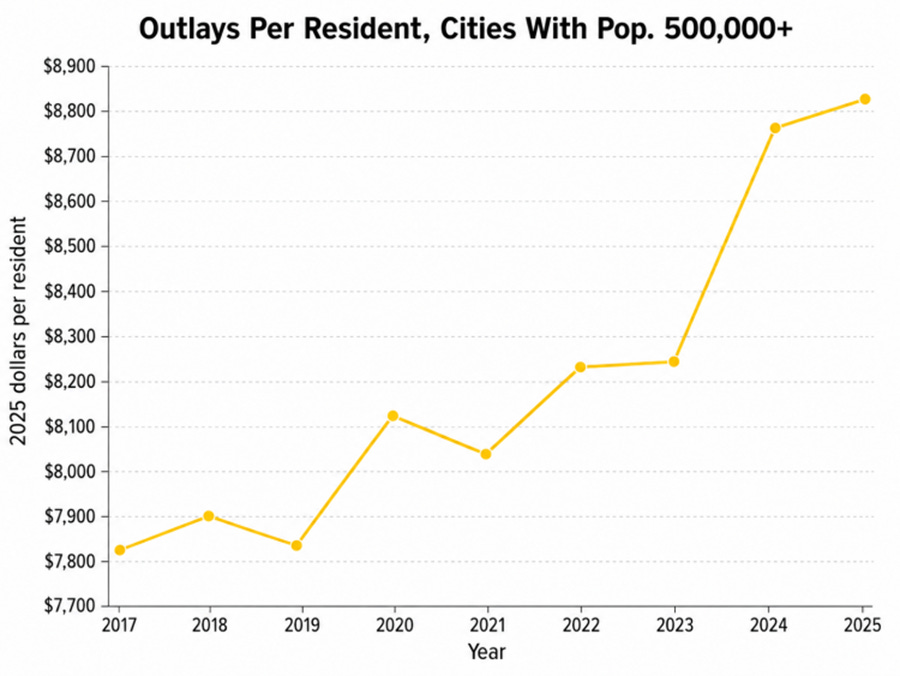
In 2016, large cities collected $6,727 of revenue per resident from local, state, and federal sources, adjusted for inflation. They spent 14% more than that: $7,685 per person.
Outlays Per Resident
RCI
By 2025, revenues had increased to $7,063 per person, but outlays had skyrocketed to $8,827. The difference of 25% is the largest gap on record since at least 1940.
Please consider subscribing for free to receive Life, Liberty, Property via email, and kindly contemplate supporting our reporting and analysis with a paid subscription of just $5 per month.
It is a spending problem, not a revenue shortfall, the report states:
The gap was not caused by low revenues. Cities earned record amounts of sales and property taxes last year. Instead, the deficits were driven by expanded bureaucracy, rising payrolls, overtime costs, and pension liabilities.
From 2017 to 2026, the public workforces of large cities grew faster than their populations. There were at least 12 cities that added new municipal jobs even though their populations dropped (A handful of cities do not disclose their staff headcounts). In an extreme example, Memphis added more than 1,000 public jobs even though the city lost more than 40,000 residents.
Many of those new hires work desk jobs. Census data shows large cities increased their administrative expenses—mayor’s offices, human resources departments, accountants, zoning departments, and more—by 55% from 2016 to 2023, accounting for inflation.
Cities are hiring administrative staff while making cuts in areas such as police and corrections. Whereas big-city political machines in the early and middle decades of the twentieth century built powerful voting blocs by paying city employees well for performing essential services, while padding the payrolls with far more workers than were needed, today’s city governments are just throwing money around with no idea of what they’re getting for it:
RCI took a look at how some representative cities have responded to major issues.
Homelessness in America’s largest cities jumped by 34% on average from 2017 to 2024, driven partly by increased housing costs and job losses during the pandemic. RCI’s analysis found no statistically significant association between increased public welfare spending and reduced homelessness.
No surprise there. Portnoy continues:
While Los Angeles is the poster child for getting little bang for the bucks it’s spent to combat homelessness, it is not alone. Seattle and surrounding King County were among the biggest spenders, with money pouring into the Regional Homelessness Authority. It was created by former Mayor Jenny Durkan in 2019 to “significantly decrease the incidence of unsheltered homelessness.” Washington State has also lifted its spending on housing construction by six times since then. But homelessness in Seattle increased at a faster rate than in any other large city but one, and rent price increases were also among the nation’s highest.
It’s easy to see where things went wrong. A state audit released in April found that the Homelessness Authority overspent its $200 million annual budget by $45 million, with portions of the money completely unaccounted for or spent on administrative expenses the city never approved. The authority is also paying individual contractors close to $500,000 annually, an amount unlikely to be seen as reasonable for a salaried public servant.
As I noted in the lead item of this issue, this high spending brings no net benefits to these cities’ residents. Poverty and income inequality remain unchanged despite the promises of pandering politicians, Portnoy writes:
Although many big cities explicitly state that their budgets are designed to reduce inequality, large cities’ Gini index—a measurement of how evenly wealth is distributed—was virtually unchanged from 2017 to 2024. So was the percentage of the population with health insurance. Poverty rates improved by 1% on average. Cities that increased their overall budgets at a faster rate were no more or less likely to see improvement in any of those three categories.
The 10 cities with the smallest topline budget increases since 2017 all saw their poverty rates drop or remain unchanged. Those 10 cities, including Minneapolis and Long Beach, now have an average poverty rate of 13.8%, lower than most of their peers.
The same is true of crime prevention, Portnoy notes: “[T]here was no statistically significant association between spending levels and violent crime rates. Cities that increased their police budgets were just as likely to see crime rates rise as cities that decreased theirs.” As I have noted regularly, law enforcement and prosecution are the keys to making city streets and homes safe.
Finally, Portnoy outlines the ways cities get around laws mandating balanced budgets. These include overly rosy estimates of expected revenues and costs, and “issuing bonds, digging into reserve funds, selling municipal property, and ignoring obligations to fund public employees’ future pension and healthcare plans.”
The last item is particularly ominous. For decades, cities across the land granted public workers lavish pension promises, obligations that are now eating up ever-greater percentages of annual government revenue. Today’s taxpayers are paying enormous sums for people who are not contributing anything to meet current service and infrastructure needs.
As the retiree-to-worker ratio continues to increase, those obligations only worsen.
To stop adding to the problem, cities can switch over to defined-contribution plans like the 401(k)s private-sector workers get, phasing out pension plans that require specific payouts from future taxpayers. Some states, however, such as Illinois, do not allow employers to put even new workers into these plans, let alone transition current workers into such a system.
Politicians have pushed the nation’s big cities into a fiscal hole they may never be able to get out of by honest means. With the federal government in a similar situation, the only viable resolutions may be urban bankruptcies and rapid monetary inflation, all arriving within a decade or so.
Nobody wants that, of course, but few, if any, politicians want to make the spending cuts that will be necessary to avert it.